
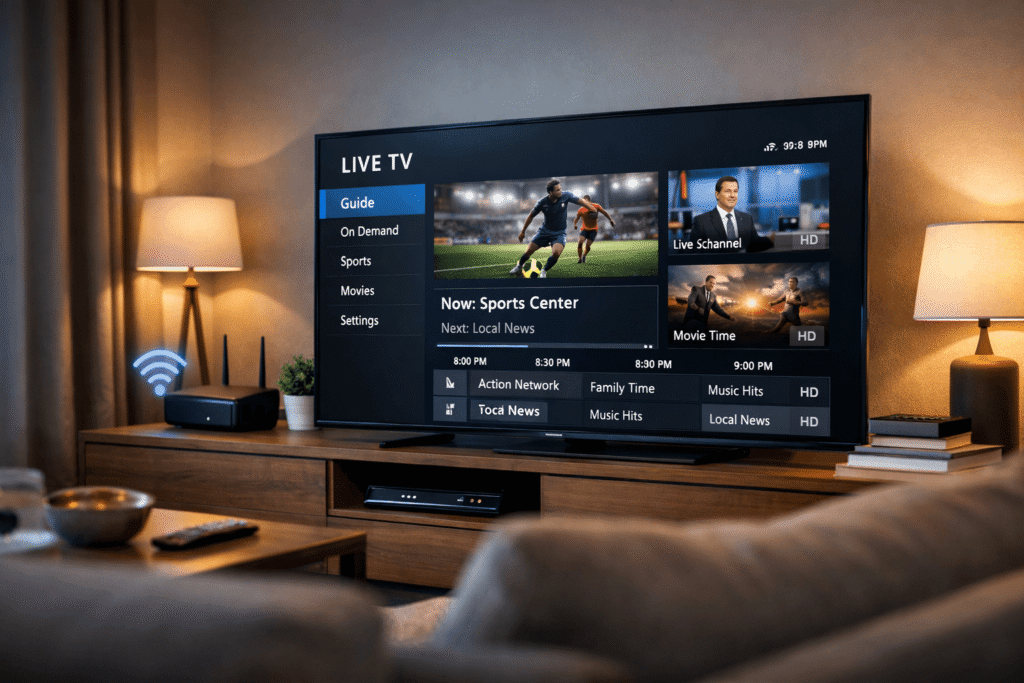
When people search for the best IPTV USA experience, they are usually not just looking for another app or a bigger channel list. Most of the time, they want a setup that feels smooth, sharp, and dependable when it matters most. They want live sports without constant quality drops, news channels that load quickly, movies that look clean on a larger screen, and a viewing experience that does not force them to troubleshoot every other night. That is why conversations around IPTV, IPTV USA services, and the best IPTV options have changed. The focus is no longer only on what service has the most channels. It is also about what actually improves viewing quality inside a real home. Better viewing depends on the full setup, including internet speed, device compatibility, app health, and network stability, not just the service itself.
That is an important shift because the phrase best IPTV USA can be misleading if it is treated too simply. There is no single best IPTV solution for every viewer in the United States. A person who mainly watches entertainment shows in one room has very different needs from a family that streams live sports across multiple screens. In the same way, a service that performs well on a newer streaming device in a stable home network may feel much weaker on an aging smart TV using crowded Wi-Fi. That is why the best IPTV, IPTV USA, and best IPTV USA discussion should include practical viewing advice rather than just rankings. A strong setup makes a bigger difference than many viewers realize.
This guide takes a different approach from the usual list-style article. Instead of centering everything on providers, it focuses on four core improvements that can help almost any IPTV USA viewer get better results. Along the way, it uses mainstream services as neutral examples rather than endorsements. The goal is to help readers understand what really drives better viewing, how to reduce common quality issues, and how to judge the best IPTV USA setup more realistically.
Why Better Viewing Matters in the Search for the Best IPTV USA Setup
A lot of people assume that better viewing simply means a higher resolution label on the screen. In reality, it is more than that. Better viewing means stable playback, fewer interruptions, sharper motion during live content, consistent performance across different devices, and a setup that does not become unreliable during peak hours. In other words, the best IPTV USA experience is about consistency as much as quality.
This matters because IPTV and IPTV USA services deliver content over the internet instead of through traditional cable infrastructure. That makes them flexible and widely accessible, but it also means there are more variables between the service and the screen. The content moves through the service’s platform, your internet connection, your home network, the device you use, and the current version of the app. If one link in that chain is weak, the result can be buffering, a softer picture, app crashes, or sudden drops in playback quality.
Once that is clear, the search for the best IPTV USA option becomes more practical. Instead of asking which brand is the winner for everyone, the better question is: what setup will give this household better viewing on a daily basis? That is the question the next four tips are designed to answer.
Tip 1: Choose the Right IPTV USA Setup for Your Viewing Habits
One of the biggest reasons viewers feel disappointed with IPTV is that they choose a service based on popularity instead of fit. In the best IPTV USA market, services are often judged by channel count, price, or sports access. Those are useful points, but they do not tell the whole story. A better question is whether the service matches your viewing habits.
For example, some IPTV USA viewers care most about live sports and local channels, while others mainly want entertainment, lifestyle content, and a stable on-demand library. Broader services may suit households that want a fuller cable-replacement style experience. Meanwhile, lighter services or more focused channel bundles may be enough for users who do not need every category of live programming.
This matters for viewing quality because overbuying a service does not always improve the experience. If your home really needs one stable stream in the evenings, a simpler IPTV USA setup may perform just as well as a more complex one. On the other hand, if several people in the home watch live TV at once, then a broader service with good device support and clearer household streaming behavior may make more sense.
The phrase best IPTV USA often gets reduced to hype, but a more professional way to look at it is through fit. A service is only the best IPTV option for your home if it covers your priorities without forcing unnecessary complexity. The more closely the service matches how you actually watch, the easier it becomes to maintain better viewing over time.
This first tip is simple but often overlooked: define your viewing habits before judging the platform. Ask whether you mostly watch live sports, entertainment, news, or general family content. Think about how many people stream at once and where they watch. That basic audit does more to narrow the best IPTV USA choice than marketing language ever will.
Tip 2: Build a Stronger Internet and Home Network Foundation
If there is one factor that affects IPTV USA viewing quality more than almost anything else, it is the health of the internet connection and home network. Streaming quality is not only about whether you have internet. It is about whether your connection fits your actual usage.
This is especially important in the IPTV USA category because live TV is less forgiving than regular on-demand playback. A movie can often buffer ahead more easily. A live sports event cannot rely on the same cushion. That means small dips in performance show up faster and feel more disruptive. When viewers complain that IPTV is inconsistent, the issue is often a mismatch between household demand and network conditions rather than a simple service failure.
A practical way to think about the best IPTV USA setup is to stop measuring speed in isolation. What matters is the speed available at the device while people are actually using the network. If two TVs are streaming, someone is gaming, and phones are backing up photos in the background, the stream may have far less bandwidth than you expect.
For many households, the answer is not automatically buying the fastest plan. Sometimes the better fix is improving the way the home network is used. A few practical changes can have a real impact:
- Test speed during the hours you actually watch TV, not only during quiet times.
- Reduce heavy downloads or cloud backups during important live events.
- Keep the main TV on the strongest part of the network whenever possible.
- Think in terms of total household activity, not one stream in isolation.
This tip matters because the best IPTV USA experience depends on stability as much as raw speed. A steady connection that supports your normal viewing pattern will often feel better than a faster connection that becomes unstable under pressure.
Tip 3: Use Better Devices and Keep Your IPTV Apps Updated
A second major source of viewing problems is the device itself. Many people still stream IPTV through built-in smart TV apps on older sets, and while that can work, it is not always the strongest setup. Supported devices, app availability, and operating requirements all play a major role in the streaming experience.
This is one of the most misunderstood parts of the best IPTV USA conversation. People often assume that if an app technically opens on a television, then the device is good enough. In reality, older smart TVs can struggle with newer app demands. They may have slower processors, less memory, weaker wireless performance, or fewer software updates. The result is an IPTV USA setup that feels unreliable even when the internet is acceptable.
In practice, one of the easiest ways to improve IPTV viewing is to test the same service on another supported device. If playback looks better on a newer streaming box or stick than on the built-in TV app, that is strong evidence that hardware is part of the problem. This is not a reason to rush into buying something new without thinking, but it is a reminder that the best IPTV USA setup usually depends on hardware quality too.
Keeping apps updated is just as important. App updates often include bug fixes, compatibility improvements, and playback optimizations. Ignoring them can leave your IPTV USA service vulnerable to issues that may already have been addressed. A well-maintained device, running the latest supported app version, gives you a more accurate sense of what the service can actually do.
A quick device-quality checklist looks like this:
- Does the app open slowly or crash often?
- Does one TV perform worse than another on the same network?
- Has the device gone a long time without major updates?
- Does the stream improve on a newer external device?
If the answer to several of these is yes, the device may be limiting your best IPTV USA experience more than the service itself.
Tip 4: Optimize Picture Quality, Playback Settings, and Live Viewing Habits
The fourth tip is about getting more from the setup you already have. Even when the network and device are decent, settings and habits still affect viewing quality. Many streaming apps include video quality settings, playback options, and data-use controls that can affect stability.
For IPTV USA viewers, this can make a surprising difference. If your connection is inconsistent during the evening, forcing the stream to chase the highest quality may create more interruptions than benefit. A slightly lower but stable picture can look better overall than a stream that keeps jumping between quality levels or buffering during live content.
Playback habits matter too. Large live events, big games, and peak-time premieres can put extra pressure on both the service and your home network. That is why good viewing habits are part of the best IPTV USA strategy. Before an important event, update the app, restart the device, and reduce unnecessary network traffic in the home. These are small steps, but they often prevent the most frustrating problems before they start.
Basic app maintenance also helps. Restarting the app, reinstalling it if needed, and checking device software updates remain some of the most common troubleshooting recommendations across major services. These are not flashy tricks, but they often make a noticeable difference because many playback issues are temporary rather than permanent.
The best IPTV USA setups are usually not the ones with the most dramatic tweaks. They are the ones where the user pays attention to the basics consistently. Stable settings, updated apps, and smarter live-viewing habits often make IPTV feel far more polished without changing the subscription itself.
Common Mistakes That Reduce IPTV Viewing Quality
A lot of IPTV frustration comes from habits that seem harmless but quietly hurt performance. One common mistake is relying only on an old smart TV app and assuming the service is at fault. Another is testing internet speed once, then assuming the result reflects peak evening viewing. A third is letting many devices compete for bandwidth during the same time window and then blaming IPTV for poor performance.
Another frequent mistake in the best IPTV USA search is evaluating services through hype instead of conditions. A platform may have a strong reputation and still perform poorly in a home with weak Wi-Fi coverage. Meanwhile, a simpler IPTV USA setup can look excellent in a stable environment with newer hardware. This is why realistic evaluation matters more than big claims.
Finally, many viewers wait until an important live event has already started before updating their apps, restarting the router, or checking whether the device is behaving normally. That is a small habit, but it often creates unnecessary frustration. The best IPTV USA experience is usually built in advance, not in the middle of a problem.
How to Evaluate the Best IPTV USA Experience Without Relying on Hype
A professional way to evaluate IPTV, IPTV USA services, and the best IPTV category is to look at three layers together. First, look at content fit. Does the service align with what you actually watch? Second, look at technical fit. Is your home network strong enough for your normal usage? Third, look at device fit. Are you streaming through supported, updated hardware?
Once you do that, the best IPTV USA question becomes much easier to answer. You stop searching for a universal winner and start identifying the setup that performs best in your environment. That is a more useful standard because it reflects real-world viewing instead of generic claims.
It also keeps the article neutral, which matters. Different services can be appropriate examples for different households. A broad cable-replacement style platform may work well for one family, while a lighter IPTV option may be enough for a smaller home. The point is not to overpraise one provider. It is to understand the conditions that produce better viewing across the category.
FAQs
What does best IPTV USA really mean?
In practice, best IPTV USA means the service and setup that deliver the most reliable viewing for your household. That includes content fit, internet quality, device compatibility, and playback stability, not just channel count.
Does faster internet always fix IPTV problems?
Not always. More speed helps, but stability, home network usage, and device quality matter too. A crowded or unstable network can still cause issues even if the plan looks fast on paper.
Are smart TV apps enough for IPTV USA streaming?
Sometimes, but not always. Newer external streaming devices often provide a smoother experience than older built-in TV apps, especially when the television hardware is outdated.
Why does live TV expose more problems than on-demand content?
Live TV has less room to buffer ahead, so network dips become noticeable more quickly. That is why sports and live events often reveal setup weaknesses faster than regular streaming.
Should I lower video quality to improve playback?
If your connection is unstable, yes, that can help. A steady HD stream usually feels better than a higher-quality stream that keeps stopping.
How can I judge IPTV USA services fairly?
Test them on a supported, updated device, during your normal viewing hours, on the same network conditions you use every day. That gives a more realistic result than judging based on reputation alone.
Conclusion
Getting the best IPTV USA experience is not about chasing hype. It is about building a setup that supports better viewing in a practical, repeatable way. The strongest results usually come from four things working together: choosing an IPTV USA setup that matches your viewing habits, giving it a stable internet and home network foundation, using supported and updated devices, and optimizing playback settings and live-viewing routines. When those pieces are in place, IPTV becomes smoother, sharper, and far less frustrating.
The main takeaway is simple. Do not judge IPTV, IPTV USA services, or the best IPTV category by brand name alone. Audit your setup first. Check your network during peak hours. Test your service on a better device if needed. Update the app before major live events. Those steps will tell you far more than a sales pitch ever will. Use this guide as your checklist today, improve one part of your setup at a time, and you will be much closer to the best IPTV USA viewing experience for your home.